Each week, you will write 1 written response: these are opportunities for you to practice using vocabulary and building the foundations for sound academic arguments so you can express your opinions on subjective matters with confidence.
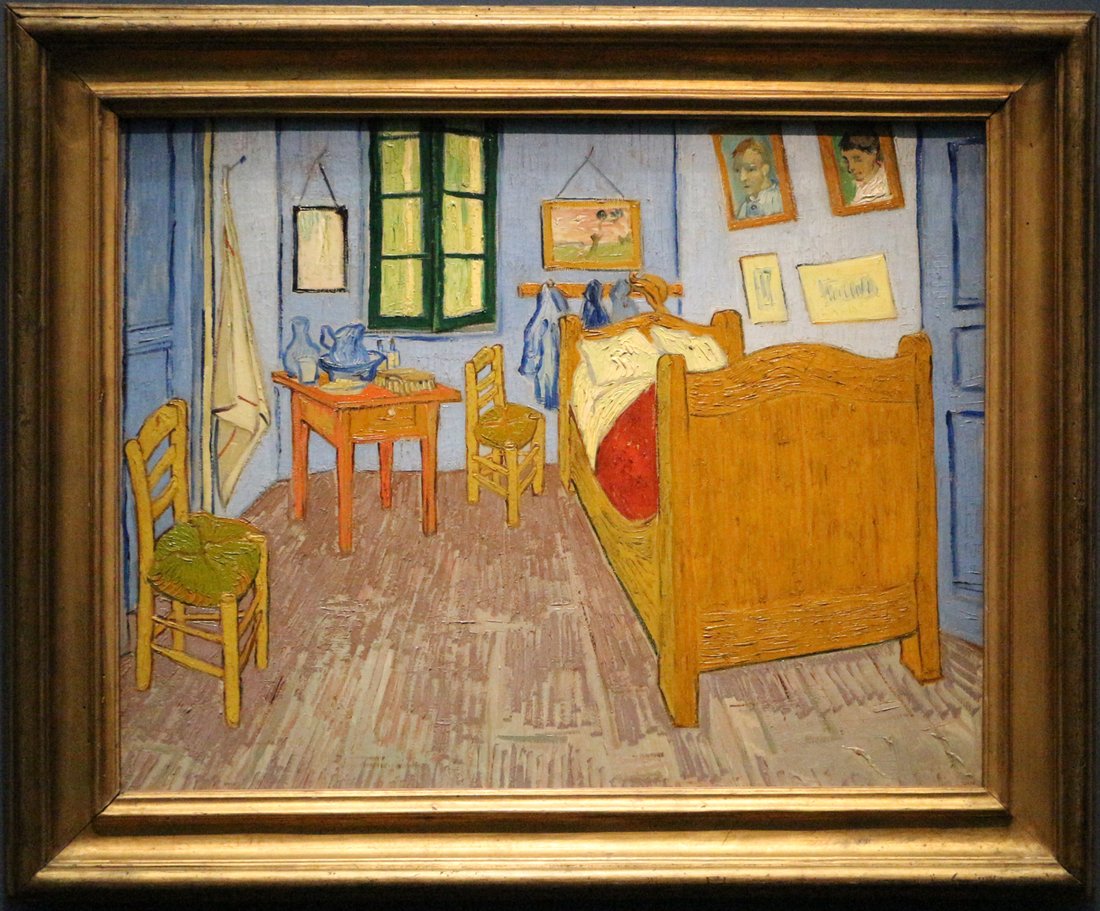
"Bedroom in Arles" by Vincent Van Gogh. 1889.
 Art Institute of Chicago.
First, read pp. 2–6 from your Sophia Tutorials Reading handout: the section on Composition in Art. Follow the instructions to do your own analysis of Vincent Van Gogh's "Bedroom in Arles," starting on page 5.
Van Gogh struggled with recurring episodes of mental illness, and during the time that he painted the three versions of this bedroom, he was ordered by his doctor to rest and recuperate. One of Van Gogh's intentions was to create a sense of rest. As you analyze the painting, consider whether or not you think that the painting conveys a sense of rest. Why or why not?
Van Gogh wrote to his brother Theo about the paintings:
"This time it simply reproduces my bedroom; but colour must be abundant in this part, its simplification adding a rank of grandeur to the style applied to the objects, getting to suggest a certain rest or dream. Well, I have thought that on watching the composition we stop thinking and imagining. I have painted the walls pale violet. The ground with checked material. The wooden bed and the chairs, yellow like fresh butter; the sheet and the pillows, lemon light green. The bedspread, scarlet coloured. The window, green. The washbasin, orangey; the tank, blue. The doors, lilac. And, that is all. There is not anything else in this room with closed shutters. The square pieces of furniture must express unswerving rest; also the portraits on the wall, the mirror, the bottle, and some costumes. The white colour has not been applied to the picture, so its frame will be white, aimed to get me even with the compulsory rest recommended for me. I have depicted no type of shade or shadow; I have only applied simple plain colours, like those in crêpes."
Analysis time: What is your initial feeling about the painting (your gut reaction)? What are the most significant compositional elements in this artwork? Pick 2–3 elements & a principle that you think are emphasized in the work. Explain.